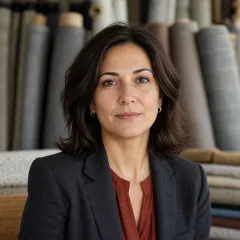
Seven years ago, I took over fabric sourcing for a mid-sized furniture company. I manage a budget of roughly $450,000 a year across curtains, upholstery, and bedding fabrics. I've negotiated with 40-something vendors since then—some excellent, some mediocre, a couple I still have nightmares about. And I've documented every order in our cost tracking system, which is the only reason I can give you actual numbers instead of vibes.
When I started, I assumed the smart play was to find the best specialist for each material. A velvet mill. A sheer curtain specialist. A leather supplier. A chenille expert. Basically the "best of everything" approach. It made sense on paper. It worked out less well in practice.
If you're a brand, wholesaler, or distributor trying to figure out where to source home textiles, you're probably at the same fork in the road I was:
Option A: Work with one full-range manufacturer that covers the whole spectrum—curtains, upholstery, bedding, the works. Welspun Living is the example I know best from the Indian textile market.
Option B: Split your orders across multiple specialized mills and manage the coordination yourself.
Both work. I've seen companies pull off both. But they're completely different experiences. Here's how I compare them, on four fronts: total cost of ownership, quality consistency, private label support, and how they handle small orders.
1. Total Cost: The Quote Is Never the Whole Story
Early on, I compared unit prices. That was a rookie mistake. It took me about three years and 60-ish orders to understand that the cheapest quote is usually the most expensive option once you count everything around it.
Actual example from 2023: I was sourcing velvet for a sofa line. A specialist mill quoted $8.20 per meter. A full-range manufacturer quoted $8.90. The specialist looked like the obvious winner—until I ran the total cost of ownership spreadsheet that I now use for every sourcing decision.
The specialist's quote didn't include:
- Sample shipping: $60 per batch, and we ordered six rounds before finalizing
- Color matching: $350 per development
- Compliance documentation: $200 per fabric for OEKO-TEX paperwork
- Pallet handling fees that showed up as a surprise line on the first invoice
By the time everything landed, the specialist was effectively $9.50 per meter—about 16% more than their quoted price. The full-range manufacturer's $8.90 had those costs rolled in. I almost went with the specialist based on the headline number alone. Good thing I checked.
Now, to be fair, that's one case. But across roughly 200 orders over six years in our system, I found that about a third of our budget overruns came from hidden fees at specialized mills—not from base prices. We implemented a policy that every vendor quote gets a TCO review before approval, and our overruns dropped by maybe 40%. Give or take a few points.
2. Consistency: Color Matching Across a Range
Anyone who's built a living room collection knows this scenario. You're producing a sofa in chenille, a recliner in leather, a set of velvet curtains to tie it together. You order from three different mills because each is "the best" in their niche.
Then the chenille arrives a shade lighter than the velvet. The leather hand feel is different from the sample. The velvet's color fastness doesn't match the lab report. Now you're the referee in a three-way dispute, and each vendor is confident the problem is someone else's fabric.
Industry standard for color tolerance is Delta E below 2 for brand-critical colors, per Pantone's matching guidelines. Delta E of 2 to 4 is noticeable to trained observers; above 4 is visible to most people. When you split a collection across mills, you're asking three different dye houses to hit the same Delta E on different base fabrics. That's genuinely hard, even for experienced suppliers.
Ask about Martindale abrasion results, too. That's the standard test for upholstery durability—residential fabrics should handle 15,000 to 20,000 rubs, while heavy commercial use starts around 30,000. A sofa fabric supplier worth working with should share those numbers without being asked twice.
A manufacturer that controls the full process—from greige fabric to dyeing to finishing—has a much easier job keeping your range visually consistent. Welspun India products cover everything from sheers to velvets to faux leather, so you're working with one color management system across your whole collection. If you're selling to retailers, that consistency is part of your brand promise.
I should add that specialists aren't always the problem. In my experience, a mill that's done 20 years of velvet will beat a generalist at velvet every time. But they'll rarely match a full-range manufacturer across categories. And a sofa fabric supplier that can't keep your whole living room collection coordinated is a liability, no matter how good their hero product is.
3. Private Label and OEM: The Hidden Workload
If you're selling under your own brand, you're not just buying fabric. You need private label support: your own SKUs, specific labeling, packaging specs, compliance files. This is where the comparison really shifts.
Private label with multiple specialists means you're the general contractor. You're coordinating:
- Chenille fabric private label specs with one mill
- Cutting and sewing with a workshop
- Packaging with another vendor
- Compliance documentation from all of them
That's manageable if you have a sourcing team. We don't. It's me and one assistant, and there was a period where we were drowning in Excel tabs and email threads.
Here's what surprised me: I kept assuming we'd get better pricing by managing each step separately. When I compared the numbers in Q2 2024, switching our private label projects to a full-range manufacturer saved us about $8,400 a year in coordination costs—roughly 17% of the project budget. Not because their unit prices were lower. Because we stopped paying for our own mistakes.
If you need chenille fabric private label or a leather fabric manufacturer that handles the whole chain, a comprehensive producer like the Welspun Living home textiles division is hard to beat. One spec sheet. One approval process. One point of contact when something goes wrong. For a small team, that's enormous.
4. Small Orders: The Surprising Reality
I have a strong opinion here, and it goes against what most buyers assume.
There's a myth that large manufacturers won't give you the time of day if you're ordering a few hundred meters. Some don't, honestly. But I've learned that order size is a poor predictor of how you'll be treated.
I've had a massive mill take a $200 sample order seriously and come back with genuinely useful feedback. I've also had a small specialty supplier make me feel like a nuisance on a $2,000 order. The correlation between size and service just isn't there.
Small doesn't mean unimportant. I can trace our current relationship with one of our best suppliers back to a $600 trial order in 2018. Today we're placing $20,000 orders with them. The vendors who took my small orders seriously are the ones I still use for the big ones.
So when you're evaluating what to look for in a sofa fabric supplier, ask about their onboarding process. Ask if they'll work with a trial order. A manufacturer that welcomes small customers today is a lot more attractive when your volume grows.
I remember the internal debate before giving our main manufacturer a trial order for the chenille line. The upside was simplifying our entire supply chain. The risk was missing a production deadline if the quality didn't match. We calculated the worst case: a complete redo at $3,500 and a late launch. The expected value said go for it, but honestly, the downside felt scary.
We approved it. For the two weeks until delivery, I second-guessed myself constantly. Then the QC report came back clean—all three colorways within Delta E tolerance on the first attempt. I was annoyed, and relieved. That supplier has had our chenille business ever since.
So, Which Should You Choose?
I'm not going to give you a universal answer, because the right choice depends on your situation. Here's how I think about it now:
Stick with specialists if:
- You're sourcing one product type at high volume, and you know it inside out
- You have a sourcing team that can manage multiple vendors
- Your SKU count is small—under 10
Consider a full-range manufacturer if:
- You're building a coordinated range across curtains, upholstery, and bedding
- You need private label or OEM support without a huge internal team
- Color and quality consistency across categories is make-or-break for your brand
The way I see it, the real question isn't "specialist vs. generalist." It's which model matches your workflow and your team size.
If you're a small brand launching a home textile collection with chenille, velvet, and leather pieces, managing four mills might sound normal. It didn't scare me seven years ago either. But after hundreds of orders and a stack of lessons learned, I'd rather have one strong partner who knows my specs, my quality bar, and my deadlines. That's what I look for in a sofa fabric supplier now. And if I were starting over, it's what I'd look for on day one.
Bottom line: choose the model that simplifies your operation without compromising quality. For us, that meant consolidating with one manufacturer. For you, it might be different. Just make sure you're comparing total cost—not the price per meter.